
R&D Tax Credits UK: Eligibility, Qualifying Costs & How to Claim in 2026
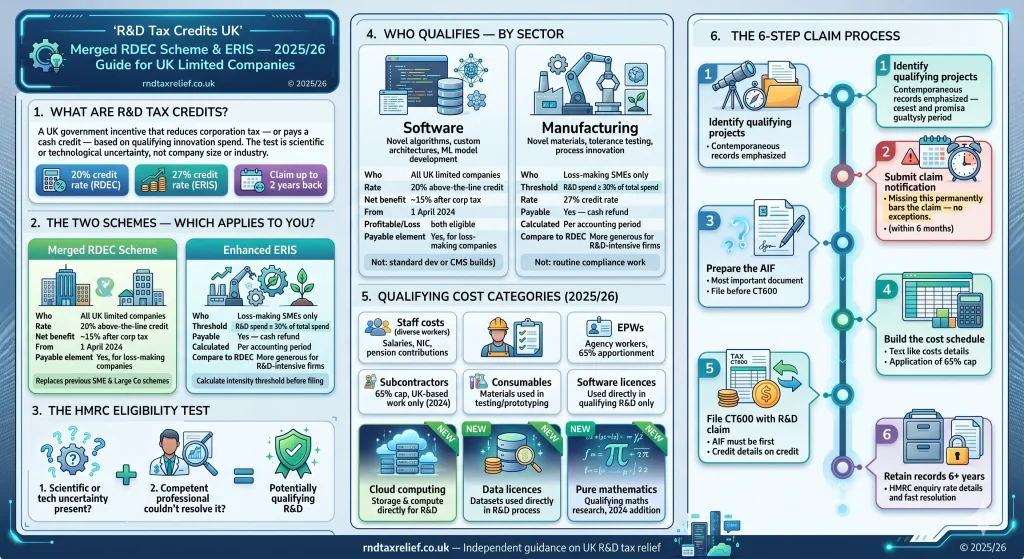
R&D tax credits allow UK limited companies to recover a proportion of their innovation expenditure through a reduction in corporation tax or a direct cash credit from HMRC. Under the 2024 Merged RDEC Scheme, the headline credit rate is 20% of qualifying expenditure with an enhanced 27% rate available to R&D-intensive loss-making SMEs under ERIS.
This guide covers who qualifies, what costs are claimable, how HMRC assesses claims, and what the mandatory Additional Information Form (AIF) requirement means for your claim in 2026. Where relevant, we can connect you with registered R&D tax advisers qualified to prepare and submit claims on your behalf.

What Are R&D Tax Credits?
R&D tax credits are a UK government incentive that reduces a company’s corporation tax liability or generates a payable cash credit in proportion to qualifying innovation expenditure.
The scheme is administered by HMRC and defined by the Department for Science, Innovation and Technology (DSIT). Contrary to common assumption, eligibility has nothing to do with having a dedicated “R&D department” or working in a traditional science sector. The test is entirely based on the nature of the work: specifically, whether it sought to resolve a scientific or technological uncertainty that a competent professional in that field could not have resolved using existing knowledge.
As of April 2024, most UK companies now claim under the Merged R&D Expenditure Credit (RDEC) scheme, which replaced the previous SME and large company schemes. A separate track Enhanced R&D Intensive Support (ERIS) applies to loss-making companies where qualifying R&D expenditure exceeds 30% of total expenditure. Understanding which scheme applies is the first compliance decision any claimant must make.
What to look for in an R&D Tax Credits Specialists in 2026
With the transition to the Merged R&D Expenditure Credit (RDEC) scheme and the introduction of Enhanced R&D Intensive Support (ERIS), the role of a specialist has shifted from calculation to rigorous compliance defense. A qualified specialist should provide:
- Mandatory AIF Technical Narratives: Full preparation of the Additional Information Form, ensuring technical descriptions align with DSIT guidelines to survive HMRC’s automated risk profiling.
- Deadline & Notification Management: Proactive handling of the 6-month post-period-end notification rule for new claimants to prevent claim invalidation.
- Modern Cost Inclusion: Specialized knowledge in qualifying Cloud Computing, Data License fees, and Pure Mathematics, while navigating the strict 2024/25 restrictions on Overseas R&D and Subcontracted work.
- HMRC Transparency: Alignment with the 2026 Tax Adviser Registration standards, ensuring your claim is submitted by a recognized and accountable agent.
- Technical Baseline Assessment: Using “Competent Professionals” to benchmark your innovation against the current state-of-the-art, rather than just routine industry development.
Who Qualifies for R&D Tax Relief in 2025/26?
EEligibility is determined by the nature of the work, not the industry, company size, or job titles involved.
The core test: Did the project seek to advance overall knowledge or capability in a field of science or technology? And was there a genuine uncertainty at the outset that a competent, experienced professional could not resolve by consulting existing published knowledge?
If yes to both, the project is a candidate. Common qualifying contexts include:
Software and technology companies: Custom algorithm development, machine learning model architecture decisions where published techniques were insufficient, novel API integrations where standard libraries failed. Note: standard website builds, app development following documented frameworks, or system configurations using established tools do not qualify.
Manufacturing and engineering: Material behaviour under novel conditions, tolerance testing beyond published specifications, process improvements where existing machinery or methods could not achieve the required outcome after reasonable attempts.
Construction and built environment: Structural engineering problems requiring bespoke calculations where standard design codes were insufficient, novel application of materials in untested configurations.
Fintech and financial services: Regulatory compliance systems requiring novel technical approaches, real-time processing architectures where no established off-the-shelf solution existed.
Life sciences and pharma: Clinical formulation work, novel compound synthesis, device development where regulatory requirements exceeded existing technical capabilities.
Routine work applying existing knowledge, following standard professional practice, or optimising known processes within their established parameters does not qualify, regardless of cost or complexity.
What Changed: The 2024/25 Regulatory Landscape
The R&D tax credit regime underwent its most significant structural reform in twenty years between 2023 and 2024. Understanding these changes is essential before preparing any claim for accounting periods starting on or after 1 April 2024.
The Merged RDEC Scheme (in force from April 2024) The previous two-track system (SME Relief and RDEC for large companies) has been replaced by a single Merged Scheme operating as an above-the-line credit. The headline credit rate is 20% of qualifying expenditure, with an effective net benefit of approximately 15% after tax for profitable companies.
Enhanced R&D Intensive Support (ERIS) Loss-making SMEs whose qualifying R&D spend represents at least 30% of total expenditure can claim under ERIS, which provides a more generous 27% credit rate with a payable element. The intensity threshold must be calculated on a period-by-period basis.
The mandatory Additional Information Form (AIF) Since August 2023, all R&D claims require submission of an Additional Information Form before the company tax return is filed. The AIF requires technical project descriptions aligned with DSIT guidelines, including identification of the scientific or technological baseline, the specific uncertainties encountered, and how the work attempted to resolve them. Claims submitted without a valid AIF are invalid.
The 6-month notification rule Companies making their first R&D claim — or that have not claimed in the previous three years — must submit a claim notification to HMRC within six months of the end of the accounting period. Missing this deadline permanently bars the claim for that period.
Overseas R&D and subcontractor restrictions (2024/25) Qualifying expenditure on externally provided workers and subcontractors is now restricted to work carried out in the UK, with narrow exceptions for work that is not reasonably practicable* to carry out in the UK due to geographic, environmental, or regulatory requirements. This restriction eliminated large portions of previously claimable overseas subcontract costs.
New qualifying cost categories Cloud computing and data hosting costs directly attributable to qualifying R&D activity, data licence fees, and expenditure on pure mathematics now qualify as eligible costs within the Merged Scheme.
What Costs Can Be Claimed?
Qualifying expenditure must be both eligible in category and directly attributable to qualifying R&D activity. The following cost types are claimable under the Merged Scheme:
Staff costs: Gross salaries, employer National Insurance contributions, and employer pension contributions for employees directly engaged in R&D. Time apportionment is required for employees who split their time between R&D and other activities.
Externally Provided Workers (EPWs): Agency workers supplied through staffing arrangements where the agency bears the employment risk. A 65% apportionment cap applies.
Subcontractors: Costs for work contracted to third parties that directly contributes to qualifying R&D, subject to 65% apportionment and the UK territorial restriction described above.
Consumables: Materials, utilities, and other items consumed or transformed during the R&D process. Items that become part of a product that is subsequently sold must be excluded.
Software licences: Licences for software used directly in R&D (development environments, simulation tools, specialist analytical software). General business software does not qualify.
Cloud computing and data hosting: A 2024 addition: costs for cloud compute, storage, and data hosting directly attributable to R&D can now be included. Proportional apportionment is required.
Data licence fees: Licence fees for datasets used directly in the R&D process (e.g. training data for machine learning projects, market data used in algorithmic research).
Pure mathematics: Qualifying expenditure where mathematical research forms part of a broader scientific or technological advance.
Capital expenditure is generally excluded, though some costs eligible under other relief schemes may overlap.
How HMRC Reviews R&D Claims
HMRC reviews R&D claims through a combination of automated risk profiling and manual compliance checks. Understanding this process is important because the standard of evidence required has materially increased since 2023.
The competent professional standard HMRC assesses technical merit by reference to whether a competent professional someone with the training and experience typical in the relevant field could have resolved the uncertainty using knowledge and techniques that were publicly available at the time. This is an objective, field-specific standard. “We couldn’t figure it out internally” is not sufficient; the question is whether the field itself had a solution.
Automated risk profiling via the AIF HMRC’s systems analyse AIF submissions for consistency with DSIT guidelines. Red flags include: generic project descriptions that could apply to any company, claims where the stated uncertainty is routine professional practice, and claims where the qualifying activities appear to describe normal product development rather than innovation.
HMRC enquiries If a claim is selected for review, HMRC typically issues a written enquiry requesting technical justification, cost schedules, and evidence of the claimed uncertainties. The company has a statutory right to respond within a specified period. Enquiry rates have risen significantly since 2022, with particular scrutiny on software and construction claims.
Compliance record HMRC considers a company’s claims history. Repeated claims in the same categories without evolving technical complexity can attract additional scrutiny.
The Claim Process Step by Step
Step 1 — Project identification and scoping (well before period-end) Identify projects where technical uncertainty was present. This is ideally done during the accounting period, not retrospectively. Contemporaneous technical records are significantly stronger evidence than post-hoc reconstructions.
Step 2 — Claim notification (within 6 months of period-end, for eligible companies) New or lapsed claimants must submit a claim notification to HMRC. This is a legal prerequisite not submitting it invalidates the claim regardless of technical merit.
Step 3 — AIF preparation Draft the technical project narratives to DSIT standards. Each qualifying project requires a description of: the scientific/technological baseline at project start, the specific uncertainty, the work undertaken to resolve it, and the outcome. This is the document HMRC will use to assess technical eligibility.
Step 4 — Cost schedule preparation Quantify qualifying expenditure by category. Apportion staff time using timesheet records or reasonable estimation methodologies. Document cloud, data, and subcontractor costs with supporting contracts and invoices.
Step 5 — Corporation tax return submission The AIF must be submitted before the CT600. The claim is made within the tax return and the credit is applied against the corporation tax liability, with any excess refunded or carried forward.
Step 6 — Post-submission Retain all supporting documentation for a minimum of six years. If HMRC opens an enquiry, you will need to produce technical records, correspondence, and cost evidence on request.
What to Look for in an R&D Tax Credit Specialist
The role of an R&D adviser has changed materially with the introduction of mandatory AIF requirements and the Tax Adviser Registration standards. Choosing an unqualified or inexperienced provider now carries direct compliance risk, not just quality risk.
A credible specialist in 2026 should be able to demonstrate:
Regulatory registration and accountability. From April 2026, HMRC requires that R&D claims be submitted by a registered tax adviser under the new Tax Adviser Registration regime. Verify that any adviser you engage is registered and can be identified as the authorising agent on your CT600.
AIF technical narrative expertise. The AIF is where most claims are won or lost. Ask any prospective adviser to show you an example (anonymised) AIF narrative. Generic descriptions that could apply to any company are a red flag.
Scheme determination capability. Advisers should be able to clearly explain whether your company falls under the Merged Scheme or ERIS, and how the 30% intensity threshold is calculated for your specific expenditure profile.
HMRC enquiry experience. With enquiry rates elevated, ask about their track record defending claims under investigation. A specialist who has never handled an HMRC enquiry is a significant risk if yours is selected.
2024/25 cost category knowledge. Specifically: cloud computing, data licences, pure mathematics, and the UK territorial restrictions on subcontractors. Many advisers trained under the old regime have not updated their cost qualification methodology.
No upfront fees contingent on claim outcome without full disclosure. Contingency fee arrangements are not prohibited, but must be disclosed and should be evaluated carefully they create incentives to maximise claim size rather than ensure compliance.
R&D Tax Credits by Sector
The qualifying test is the same across all sectors, but the practical application of the “competent professional” and “uncertainty” standards varies considerably by field.
- Software and technology: Uncertainty is often at the algorithmic, architectural, or performance boundary. Standard implementation projects don’t qualify; novel technical approaches do.
- Manufacturing: Process improvements where existing techniques, materials, or tolerances were genuinely insufficient, rather than optimisation within known parameters.
- Engineering: Structural, mechanical, or systems engineering where published standards or existing design tools were inadequate.
- Fintech: Processing speed, security architecture, or regulatory compliance systems requiring novel technical solutions.
- Construction: Bespoke structural calculations, novel material applications, or project-specific technical problems with no established industry solution.
- Life sciences: Formulation development, device engineering, novel compound synthesis, and clinical process development.
FREQUENTLY ASKED QUESTIONS
Q: Can a small business claim R&D tax credits?
Yes. There is no minimum company size. The Merged RDEC Scheme applies to all UK limited companies regardless of revenue or headcount, provided the work meets the scientific or technological uncertainty test.
Q: How far back can I claim?
R&D claims can generally be made within two years of the end of the accounting period in which the expenditure was incurred. For periods ending after April 2023, the AIF submission requirement and (for new claimants) the 6-month notification rule also apply.
Q: Do I need a dedicated R&D team to qualify?
No. The test is based on the nature of the work, not how it is organised internally. A sole developer, an engineering team, or a mixed commercial-technical team can all carry out qualifying R&D.
Q: Is the AIF the same as the technical report?
The Additional Information Form (AIF) is a mandatory HMRC submission that must be filed before the CT600. It includes technical project descriptions and cost information. It replaces what was previously an optional technical narrative and is now a legal prerequisite for a valid claim.
Q: What happens if HMRC enquires into my claim?
HMRC will issue a written notice requesting additional evidence to support the technical and financial elements of the claim. You or your adviser must respond within the specified period, typically 30–60 days. Claims with strong AIF narratives and contemporaneous records resolve significantly faster than those reconstructed retrospectively.
Q: Does my software development qualify?
Software R&D qualifies where there was genuine technical uncertainty that a competent software professional could not have resolved using existing frameworks, languages, or techniques. Standard website development, CMS implementation, or API integration using documented methods does not qualify.
Q: What is the difference between the Merged Scheme and ERIS?
The Merged RDEC Scheme applies to all UK limited companies making R&D claims from April 2024 onwards, providing a 20% above-the-line credit (approximately 15% net after tax). ERIS applies specifically to loss-making SMEs where qualifying R&D expenditure is at least 30% of total company expenditure, with a more generous 27% credit rate.
Q: Can I claim for work done by overseas subcontractors?
From April 2024, qualifying R&D expenditure on subcontractors is generally restricted to work performed in the UK. Narrow exceptions exist where it is not reasonably practicable to perform the work in the UK due to geographic, environmental, or other regulatory requirements but the burden of demonstrating this falls on the claimant.

HMRC and R&D Tax Relief: A Complete Guide for UK Businesses

R&D Tax Relief for TV and Film: How Innovation Gets Funded in the UK
The Link Between R&D Tax Relief and Business Growth

Planning Client Finances With R&D Tax Relief

Integrating R&D Tax Credits into Cash Flow Planning for Business Success

How R&D Tax Relief Supports Financial Risk Management in the UK
Book a call back
Contact one of our England, United Kingdom based r&d tax relief advisor by filling this form our email us: [email protected]
Bala Cl, Stretford, Salford M5 4BB United Kingdom